Las Vegas Paiute Tribe

Health & Human Services

Providing comprehensive outpatient health care in collaboration with Indian Health Services to all federally recognized Native American tribal citizens.

(702) 382-0784

Not an Emergency Facility

We are not an emergency or urgent care facility.

If you require immediate emergency services or urgent care, please call 911 or go to the nearest Emergency Room.

Our Mission

To improve the health status and quality of life for our patients by providing them culturally appropriate and holistic healthcare.

To promote a balanced physical, emotional and spiritual lifestyle.

Structure & Operations

Las Vegas Paiute Tribe Health & Human Services is operated by the Las Vegas Paiute Tribe in collaboration with Indian Health Services that provides Medical, Dental, Optical and Behavioral Health outpatient services to all North American Federally Recognized Native American Tribes.

Our Services

Las Vegas Paiute Tribe Health & Human Services specializes in outpatient health care and health education in collaboration with Indian Health Services for all federally recognized Native American tribal citizens.

Outpatient Health Services

  • • Illness diagnosis & treatment
  • • Adult, Geriatric, Adolescent & Pediatric Care
  • • Diabetes Mellitus Management
  • • Physical (DOT/CDL/Well Child Check/School/Camp/Sports)
  • • Limited Laboratory Services
  • • Audiology (Hearing Screening)
  • • Nutrition Counseling
  • • Well Women Exams
  • • Podiatry

Pharmacy Services

Responsive, cost-effective, high quality pharmaceutical services with reasonable access and reduced fee scale.

Prescription Refill Hotline:

(702) 382-0784 Option 6

24 hours/day, 7 days/week

Pick-up next workday

Behavioral Health Services

Support services for behavioral/mental health concerns.

  • • Family Counseling
  • • Individual Counseling
  • • Couples Counseling
  • • Group Counseling
  • • Substance Abuse Counseling
  • • Psychiatry Services

Optometry Services

Vision services using state-of-the-art instruments with reduced fee scale for frames and lenses.

Office Hours:

Mon, Wed-Fri: 8:00 AM - 4:00 PM

Call: (702) 382-0784 ext. 435

Patient Benefits Coordinator

Advocacy assistance with alternate resource programs including Medicaid, Medicare, and Private Insurance. We help determine eligibility, assist with applications, and follow up on enrollment.

S.D.P.I Program

Special Diabetes Program for Indians - providing evidence-based intervention strategies and community-based public health approach to diabetes treatment and prevention.

Identifies and develops services that address local concerns and needs.

Appointment System

We use an appointment system to reduce waiting times. Walk-in patients are welcome but next available appointment times are not guaranteed. Please give 24 hours notice if cancelling your appointment.

Schedule an Appointment

SDPI — Special Diabetes Program for Indians, Las Vegas Paiute Tribe, Managing Diabetes

Federally Funded Since 1997

Special Diabetes Program for Indians

The SDPI grant is a federally funded program established in 1997 in response to the high rates of diabetes among American Indians and Alaska Natives. The Las Vegas Paiute Tribe SDPI Grant Program uses Best Practice guidelines for patient care management and treatment set forth by the Indian Health Service (IHS).

About SDPI

Diabetes is a group of diseases characterized by too much sugar (glucose) in the blood. Active participation with the SDPI participation agreement is required.

Required to Join

  • Nevada ID card or driver's license
  • Current lease, utility bill, or car registration
  • Signed participation agreement (renewed annually)

Ready to join the SDPI program? Complete your participation agreement online.

Complete Participation Agreement

Active Participation Requirements

All SDPI members must fulfill the following as part of their care plan

01

Initial Provider Appointment

An initial appointment with a health care provider for a physical or to establish a plan of care.

02

Pharmacist Consultation

Consultations with the Pharmacist who provide education and review your medications.

03

Diabetes Educator / Dietician

An appointment with the Diabetes Educator/Dietician is required at minimum once per year. A nutrition plan will be created for you if you choose.

04

Fasting Blood Work

Fasting blood work a minimum of 3 times per year. HCV and TB screenings at diagnosis.

05

Immunizations

Hep B, Influenza, PCV, Tdap, and Zoster immunizations required.

06

Dilated Eye Exam

A dilated eye exam performed at least once per year by an optometrist or ophthalmologist.

07

Foot Exam

Foot exam once per year or as needed by the Podiatrist or primary care provider.

08

Dental Exam

Dental exam once per year. Only exams, x-rays, and cleanings are included in the diabetes grant.

09

Depression Screening

Depression screening once per year.

2026 — Las Vegas Paiute Tribe HHS

Participation in Diabetes Wellness programs and community events are encouraged.

Supplies Provided to All Grant Participants

A glucose meter, test strips, lancets, and alcohol wipes will be provided to all grant participants. Please bring your glucose meter to your appointments. Self-monitoring is vital for control of blood sugar and adjustments to medications.

November 2026 Newsletter

Clinical Appointment Hours

Current provider schedules and service hours for Health & Human Services.

Download November Newsletter (PDF)

Primary Care

Dr. Lee

Monday-Friday: 8:30 AM - 3:30 PM

Gemma (Nurse Practitioner)

Monday-Friday: 8:30 AM - 3:30 PM

Lisa Ledl (Nurse Practitioner)

Wednesday-Friday: 9:30 AM - 3:30 PM

Pediatrics & Specialty

Dr. Rowles (Pediatrics)

Monday-Wednesday: 1:00 PM - 3:30 PM

Dr. Waite (Podiatry)

Monday, Tuesday, Thursday: 8:30 AM - 4:00 PM

Wednesday: 8:30 AM - 11:00 AM

Friday (every other week): 8:30 AM - 4:00 PM

Behavioral Health

Steven Bonn, LMFT

Monday-Thursday: 9:00 AM - 3:00 PM

Dr. Cruey (Psychiatrist)

Monday-Friday: 8:00 AM - 5:00 PM

Manuela Reid, LCSW

Monday-Friday: 9:00 AM - 3:00 PM

Additional Services

Optical

Monday-Friday: 8:00 AM - 5:00 PM

Dental

Monday-Friday: 8:00 AM - 5:00 PM

Pharmacy

Monday-Friday: 9:00 AM - 4:30 PM

Wellness Center

Monday-Friday: 8:00 AM - 6:00 PM

Nutrition (Mandie)

Monday & Friday: 8:00 AM - 2:00 PM

Tuesday-Thursday: 8:00 AM - 1:00 PM

Benefits Coordinator (Tom)

Monday-Friday: 8:30 AM - 4:00 PM

To Schedule an Appointment: Call our scheduling department during business hours.

We use an appointment system to reduce waiting times. Walk-in patients are welcome, but next available appointment times are not guaranteed. Please give 24 hours notice if you need to cancel your appointment.

Call (702) 382-0784
Health & Wellness Center

Wellness Center – Fall Classes

November 2026

Center Hours

Monday – Friday: 8:00 AM – 6:00 PM

Tuesday & Thursday Classes

Tuesday classes are held every other week at the LVPT Wellness Center.

Thursday classes are held every week at a separate location.

See the November newsletter for class details

Chiropractic Services

All registered clinic patients are eligible for chiropractic services at the Wellness Center.

Available: Tuesdays & Thursdays, 12:00 PM – 6:00 PM

Call the Clinic or come into the Wellness Center to make an appointment.

November 2026 Newsletter

Las Vegas Paiute Tribe Health & Human Services

This month: preventing diabetes health problems, food and nutrition answers, staying active, mental health, and natural teeth whitening.

Download November Newsletter (PDF)
Diabetes Awareness

Preventing Diabetes Health Problems

Diabetes is a disease that occurs when your blood glucose, also called blood sugar, is too high. When it's not managed, diabetes can damage the eyes, kidneys, nerves, and heart, and is linked to some types of cancer. If you have diabetes, taking charge of your health as soon as possible may help you prevent other health problems.

Preventing Diabetes Health Problems

Manage your numbers

Manage your A1C blood glucose, blood pressure, and cholesterol levels. Ask your doctor what your goals should be, and stay informed about your A1C level.

Build healthy habits

Make lifestyle changes to slowly build healthy habits. Take small steps to eat healthier, be more physically active, and get enough sleep.

Take medicines on time

Take your medicines on time, even if you feel healthy. Talk to your doctor or pharmacist for help if you have trouble managing your medicines.

Work with your provider

Work closely with your primary care provider. They can help you prevent or manage diabetes and refer you to other health care professionals for related health problems.

Take care of your mental health

A mental health counselor may help you find healthy ways to cope with stress.

More information: niddk.nih.gov · healthinfo@niddk.nih.gov

Food & Nutrition

Food & Nutrition FAQs

Based on recommendations from the ADA's Standards of Care in Diabetes \u2014 2025. Talk to your RDN to create an eating plan to meet your needs and help you reach your health goals.

Food and Nutrition FAQs
Who on my diabetes care team do I talk to about nutrition?

Anyone on your diabetes care team can answer general questions, but it's best to talk to a registered dietitian nutritionist (RDN) about nutrition and your eating plan.

Is there one diet people with diabetes should follow?

There isn't one single “diet” for managing diabetes — there are many types of eating patterns people can follow. One place to start is the Diabetes Plate: fill half your 9″ plate with non-starchy vegetables, 1/4 with lean protein foods, and 1/4 with a quality carbohydrate. Choose a low-calorie drink like water, unsweetened tea, or coffee.

What are quality carbs I can choose?

Choose nutrient-rich, minimally processed carbs with 2.5 g of fiber or more per serving. Examples: starchy vegetables (potatoes, sweet potatoes, corn, winter squash), beans (kidney, black, pinto, chickpeas, lentils), fruits (fresh, frozen, dried, or canned in fruit juice), dairy (low-fat milk, yogurt, plant-based milk), and whole grains (quinoa, oats, brown rice, whole grain pasta, bread, and tortillas). If you take insulin, work with an RDN or certified diabetes care and education specialist (CDCES) to make sure your eating plan has the carbs needed for your insulin plan.

Do I need to lower the amount of sodium in my eating plan?

Limit sodium to less than 2,300 milligrams per day. Most sodium comes from highly processed food, so eat mostly whole foods. When buying packaged or canned foods, look for “low sodium,” “no-added-salt,” or minimally processed on the label. Low sodium foods contain 140 mg of sodium or less per serving.

Do I need to think about the amount of fat in the foods I eat?

Focus on choosing the right types of fats and keep portions small. Monounsaturated fats (olive oil, avocados, nuts, seeds) help lower “bad” LDL cholesterol while maintaining “good” HDL. Polyunsaturated fats (fatty fish, flaxseed, walnuts, sunflower oil) contain omega-3 and omega-6 fatty acids that support brain and heart health. Limit or avoid saturated fats (butter, red meat, full-fat dairy, coconut oil), which can raise LDL cholesterol and increase heart disease risk.

Learn more at 1-800-DIABETES (1-800-342-2383) · diabetesfoodhub.org

Get Active! Eat Healthier!

Exercise and Nutrition

Eating healthier and being active can help improve your blood glucose (blood sugar), blood pressure, cholesterol levels, and weight.

Exercise and Nutrition
  • Engage in at least 150 minutes or more of moderate or vigorous physical activity per week
  • Engage in resistance exercises 2-3 times per week
  • Interrupt sitting every 30 minutes
  • For older adults, complete flexibility and balance training 2-3 times per week
  • Work toward maintaining a healthy weight
  • Work with a Registered Dietitian Nutritionist to find an eating plan that's right for you

Different eating plans can be considered for preventing and managing diabetes — visit diabetesfoodhub.org for eating plans. Not all activities are right for everyone with diabetes. Be careful when starting new activities, and check with your doctor if you have questions.

Behavioral Health

Irrational Beliefs vs. Rational Shifts

Submitted by Steven Bonn, LMFT, LCADC. Originally identified by Dr. Albert Ellis, founder of Rational Emotive Behavior Therapy.

Irrational Beliefs versus Rational Shifts

1. Seeking Approval vs. Needing It

The Old Belief

“Everyone I care about must like me at all times, and I can't tolerate anyone being upset with me.”

The New Reality

Getting approval is lovely, but it's a bonus, not oxygen. You can survive — and still be completely fine — even if someone doesn't like you.

2. Perfectionism vs. Self-Acceptance

The Old Belief

“If I fail at anything or make a single mistake, I am a total failure as a person.”

The New Reality

Aiming high is great, but expecting perfection is a trap. Your worth as a person is separate from your performance or scorecards.

3. Harsh Judgment vs. Human Reality

The Old Belief

“People must always act fairly and kindly. If they don't, they are terrible people who deserve to suffer.”

The New Reality

People act selfishly or foolishly sometimes. It's frustrating, but raging about human imperfection only hurts you, not them.

4. Entitlement vs. Adaptability

The Old Belief

“Life has to go the way I planned, or else it's completely unbearable.”

The New Reality

There's no universal law that says life must cater to your plans. Disappointments happen, and you are strong enough to adapt to them.

5. Blaming Outside Events vs. Owning Your Thoughts

The Old Belief

“Other people and bad situations make me feel miserable, and I'm helpless to change it.”

The New Reality

External events trigger situations, but your interpretation creates your emotions. You can't control everything around you, but you can train how you respond.

6. Constant Worry vs. Useful Action

The Old Belief

“If I keep obsessing over worst-case scenarios, I'll protect myself from bad things happening.”

The New Reality

Anxiety isn't a shield. Worrying doesn't stop bad events from happening; it just steals your peace in the present moment.

7. Avoidance vs. Facing Challenges

The Old Belief

“It's easier to avoid difficult tasks, uncomfortable conversations, and hard decisions.”

The New Reality

Dodging problems only gives them room to grow. Taking action early is usually far less painful than living with long-term dread and consequences.

8. Total Dependence vs. Self-Trust

The Old Belief

“I'm not strong or capable enough on my own — I need someone bigger or smarter to rely on.”

The New Reality

It's healthy to ask for advice or support, but leaning entirely on others stops you from building confidence in your own judgment.

9. Stuck in the Past vs. Living in the Present

The Old Belief

“My past experiences made me who I am, so I'm permanently stuck feeling and acting this way.”

The New Reality

Your past may explain where a belief came from, but it doesn't force you to keep it. You can examine old habits right now and choose new ones.

10. Absorbing Emotional Contagion vs. Empathy

The Old Belief

“If someone I care about is sad or stressed, I am obligated to feel just as miserable as they are.”

The New Reality

You can offer genuine compassion and a helping hand without drowning in someone else's emotional storm.

11. Comfort Trap vs. Resilient Growth

The Old Belief

“I shouldn't have to deal with pain or discomfort, and I must avoid it at all costs.”

The New Reality

Discomfort is a natural part of living and growing. Avoiding all friction makes your world smaller and smaller.

12. Demanding Perfection vs. Embracing “Good Enough”

The Old Belief

“There has to be a perfect answer to every problem, and I won't move forward until I find it.”

The New Reality

Most problems have several decent solutions. Picking a solid, workable option today beats waiting forever for a perfect one that doesn't exist.

Dental

Natural Teeth Whitening: Fact vs. Fiction

With the holidays around the corner, people always want to look their best. When the American Academy of Cosmetic Dentistry asked what people would most like to improve about their smile, the most common response was whiter teeth.

Natural Teeth Whitening

Fruits and vinegar

Fruit is a great choice as a food group, but fruit and vinegar contain acid. Prolonged contact or scrubbing your teeth with them can wear away enamel, the thin outer coating that protects you from sensitivity and cavities.

Charcoal, baking soda, and hydrogen peroxide scrubs

There is no evidence that dental products with charcoal are safe or effective, according to the Journal of the American Dental Association. Overly abrasive materials can wear through enamel and expose yellow dentin.

Spices and oils

There is no reliable scientific evidence that oil pulling or turmeric whitens teeth. Save the oil and spices for healthy meals.

Still interested in whitening?

The best natural ways to keep your teeth white are everyday healthy habits:

  • Brush your teeth twice a day for two minutes
  • Use a whitening toothpaste with the ADA Seal of Acceptance
  • Clean between your teeth once a day
  • Limit foods that stain your teeth, like coffee, tea, and red wine
  • Do not smoke or use tobacco
  • Visit your dentist regularly for checkups and cleanings (and ask about whitening)

Source: mouthhealthy.org

Community Wellness Resources

Supporting holistic wellness through community programs and cultural preservation.

Neon to Nature

Connect with nature through community wellness events and outdoor activities that promote physical and mental health while honoring tribal traditions.

Pop-Up Produce

Access fresh, healthy foods through our Pop-Up Produce programs providing nutritious options to tribal members and promoting healthy eating habits.

Nutrition Tip: The Diabetes Plate

Fill half your 9-inch plate with non-starchy vegetables, one quarter with lean protein, and one quarter with a quality carbohydrate. Choose water, unsweetened tea, or coffee to drink.

Patient Registration

New and returning patients must complete our patient registration form to receive care at our facility.

Form Contents

  • • Patient Bill of Rights & Responsibilities
  • • Privacy Act Notification
  • • HIPAA Notice of Privacy Practices
  • • General Consent for Care & Treatment
  • • Insurance & Coverage Information
  • • Emergency Contact Details
  • • Medical History Overview

What to Bring

  • • Valid Photo Identification
  • • Insurance Card (if applicable)
  • • List of Current Medications
  • • Any Previous Medical Records
  • • Tribal Enrollment Documentation
  • • Emergency Contact Information

First Time Visiting? Allow 30-45 minutes for registration and intake. Complete the form as accurately as possible to ensure we have your complete medical history for better care.

You can download the form below and bring it completed to your appointment, or arrive early to complete it at our facility.

No Show Tolerance Policy

Important policy for scheduling and appointment management

Policy Overview

If you NO SHOW 3 consecutive appointments, your scheduling privileges will be declined for 3 months.

Key Requirements:

  • • Call at least 2 hours prior to appointment to cancel
  • • Late cancellations will be considered a NO SHOW
  • • After 3 no-shows, your account will be restricted for 3 months
  • • Contact scheduling for any questions or concerns

What You Should Know

  • • We understand that circumstances arise, so we ask for timely cancellation notice
  • • Cancellations made 2+ hours in advance will not count against your record
  • • This policy helps us provide timely care to all community members
  • • If you need to reschedule, please call our scheduling department
  • • After 3 months of no further no-shows, your privileges will be restored
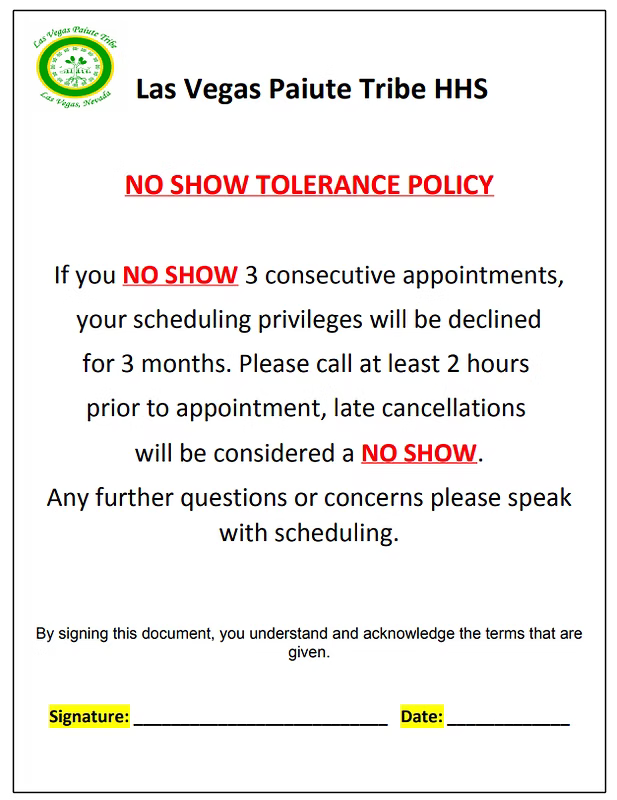
No Show Tolerance Policy Document

Get in Touch

Phone

(702) 382-0784

Hours

Mon-Fri: 8:00 AM - 6:00 PM

Location

1257 Paiute Circle
Las Vegas, NV 89106